








Some of Asia’s major jurisdictions are witnessing key developments in patent law, from enforcement to embracing new technology. Our comparisons shed some light.
| Navigation |
| China | India | Korea |
Patent law in China
In Chinese patent litigation practice, the amount of damages obtained by the patent holder is often too low. The “principle of indemnity” has also been adopted too often for the relief of infringements in judicial practice, and has led to the profits of infringers being far higher than the amounts of compensation attained, which seriously damages the interests of patent holders, fuelling further intentional infringement of intellectual property (IP) rights and undermining the effectiveness of the IP legal system in stopping infringements.

Deputy Director, Patent Litigation Department at CCPIT Patent and Trademark Law Office in Beijing
Tel: +1 408 855 8628
Email: yanggx@ccpit-patent.com.cn
Article 63 of the new Trademark Law, amended in August 2013, stipulates that the amount of compensation can be determined by the losses of the patent holder, the illegal profits of the infringer, and the patent licence fee of the trademark. In case of malicious infringement of the trademark rights, if the circumstances are serious, the amount of compensation may be determined by more than one time and up to three times the amount determined according to the above-mentioned method. This article establishes the punitive damages in the field of the IP law.
On 5 November 2018, President Xi Jinping gave a speech at the opening ceremony of the first China International Import Expo, pointing out that China will protect the legitimate rights and interests of foreign-funded enterprises, and resolutely punish the acts that violate the legitimate rights and interests of foreign businessmen, especially the acts of infringing IP, and introduce a punitive damages system, significantly increasing the cost of illegal acts.
In April 2019, the head of the State Intellectual Property Office (SIPO) said that the fourth amendment to the Patent Law had increased the punishment for intentional infringements of patents. In cases of intentional infringement of the patent right, if the circumstances are serious, the amount of compensation may be determined within one to five times the amount calculated based on losses suffered by the patent holder, profits obtained by the infringer, or a multiple of the patent licence fee.

Senior Attorney at CCPIT Patent and Trademark Law Office in Beijing
Tel: +86-10-6604 6193
Email: luchl@ccpit-patent.com.cn
In addition, according to the Patent Law, the Chinese judiciary has no power to trial the validity of patent rights in a patent infringement lawsuit. The determination of the validity of patent rights can still only be examined by the SIPO. This practice will lead to an extended cycle of the judicial proceedings.
The judiciary has apparently discovered the above-mentioned drawbacks of the “dual-track structure” and tried to expand the court’s power to examine the validity of patent rights, or use the prior arts defence in infringement lawsuits to achieve the same non-infringement effect as the invalidation of patent rights. However, the judiciary has still failed to break through the legal regulation to directly determine the validity of patent rights in a patent infringement lawsuit.
Under the promotion of patent holders, theorists and the judiciary, the system of punitive damages and the validity defence of patent rights in patent infringement litigation have made new progress.
In order to encourage the accelerated development of scientific and technological innovation enterprises, China has launched a registration system for the science and technology innovation board (STIB) in the Shanghai Stock Exchange. The STIB mainly looks at technologically innovative enterprises, and seeing as IP is a core asset for these enterprises, it is particularly important for the healthy development of the enterprises to protect their IP.
For this reason, the Supreme People’s Court (SPC) has emphasized the need to strengthen judicial protection for enterprises listed on the STIB. On 21 June 2019, the SPC issued Several Opinions on Providing Judicial Protection for the Establishment of STIB and the Pilot Registration System Reform.
The opinions put forward strengthen the judicial protection of IP of the companies listed on the STIB, the handling of IP cases such as patent rights and technology contracts of the companies listed on the STIB, and increase the amount of compensation for IP infringements involving scientific and technological innovations, which fully reflect the market value of scientific and technological achievements.
Malicious infringers in serious circumstances must be ordered to bear punitive damages in accordance with the law, further exerting the judicial supervision function of IP, actively exploring the establishment of a validity defence system in patent infringement litigation, promoting the substantive settlement of IP disputes, and effectively safeguarding the IP and legitimate rights and interests of the listed companies.
The Several Opinions on Providing Judicial Protection for the Establishment of the STIB and the Pilot Registration System Reform proposed two highlights: the punitive damages, and the patent right validity defence.
The opinions are only applicable to the patent disputes of companies listed on the STIB, but it can still be regarded as a beneficial attempt to break through the “dual-track system” of the validity of patent rights determined by the China National Intellectual Property Administration, and the patent infringement litigation trialled by the court.
Meanwhile, at a time when the fourth amendment of the patent law in China has not yet been completed, the opinions stipulate that “the punitive damage shall be implemented for the malicious infringement in the patent infringement litigation of the listed companies”, which may also be seen as accumulating judicial experience for the fourth amendment of the patent law.
The authors believe that as the fourth amendment of the Patent Law has not been completed, the punitive damages should be applied to the malicious infringement of patent rights, the applicable conditions should be strictly limited, and the experience should be summarized in time to provide a basis for the legislation.
Only when the infringer is informed/warned of the infringement, or the evidence can prove that the infringer knew of the infringement and continued on with the illegal act – such as upon receiving a warning from the patent holder and knowing that the actions will infringe the IP of others, the infringer continues to carry out the act, or the infringer continues to carry out the infringement after the preservation order or the injunction is issued by the court or the administrative office, or the infringer continues to carry out the infringement even after receiving an infringement verdict issued by the court, or when infringing, not only knowing the infringement, but taking measures to cover up the infringement – can the act be considered a malicious infringement, and be punished.

CCPIT Patent & Trademark Law Office
10/F, Ocean Plaza
158 Fuxingmennei Street
Beijing 100031, China
Tel: +86 10 6641 2345; +86 10 6851 6688
Email: mail@ccpit-patent.com.cn
Patent law in India
The year 2018 witnessed several progressive changes to India’s patent landscape. This article aims to highlight key developments that depict the progressive approach taken by the Indian government towards intellectual property rights (IPR) in 2018. One of the most promising advances has been to create a balance between knowledge creation and spreading awareness.

Partner, LexOrbis in New Delhi
Tel: +91 9911758776
Email: rajeev@lexorbis.com
In the past year, a lot of IP awareness programmes were organized by the Indian government, for example, in association with research organizations, universities and industry associations. Cell for IPR Promotion and Management (CIPAM), which is a professional body under the aegis of Department for Promotion of Industry and Internal Trade (DPIIT), formerly the Department of Industrial Policy and Promotion, regularly organized events on issues related to IPR, aiming to tread closer to the objectives of the national IPR policy.
On the operational front, the Indian Patent Office (IPO) leaned towards technology-driven solutions – for example, by introducing the option of attending the hearing through video-conferencing – in an attempt to expedite the prosecution of patent applications while simultaneously ensuring convenience to applicants.
In August 2018, the IPO invited expressions of interest for making use of artificial intelligence (AI), block chain, internet of things (IoT), and other advanced technologies for patent processing systems. Therefore, the stakeholders can expect to see further digitization of patent proceedings in India in the near future.

Managing Associate, LexOrbis in New Delhi
Tel: +91 8750597345
Email: pankaj@lexorbis.com
In the past year, the proposal of draft rules garnered attention from all quarters. On 4 December 2018, in consultation with the IPO, the DPIIT released the draft Patent (Amendment) Rules, inviting public comment. The draft rules mainly related to international applications, expedited examinations, and pre-grant opposition.
One of the proposals was that at the time of filing an international application, the patent agents should first file all the mandatory documents electronically, and the original documents, if required, should then be submitted within 15 days from the date of electronic submission.
With regard to the expedited examination, apart from the start-up applicants and applicants selecting the IPO as the competent International Searching Authority, or as an International Preliminary Examining Authority, the facility of expedited examination may now be extended to small entities, women applicants, and government undertaking/organizations as per the proposed rules.
Further, an applicant who is eligible to file patent applications in India under an agreement –for example, through the Patent Prosecution Highway (PPH), between the IPO and another participating patent office – may also avail of the facility of expedited examination. Another significant proposal was to have a bench of controllers for deciding pre-grant opposition matters, in contrast to a single controller, as per the existing practice.

Managing Associate, LexOrbis in New Delhi
Tel: +91 8800116844
Email: piyush@lexorbis.com
In 2018, India also took a step forward in order to offer the benefits of the PPH to applicants filing patent applications in India. On 29 October 2018, an agreement was signed between Japan and India to start a pilot programme of a Japan-India PPH. Although the PPH has yet to be implemented, this step undoubtedly kick-starts another chapter of development in IPR in India. It would be fair to expect that the introduction of PPH in India will encourage more patent filings, and that while offering quicker examination of the applications.
The IPO has also been taking commendable initiatives in partnering with IP stakeholders to augment the IP experience in India, and has regularly conducted interactive meetings with stakeholders to improve patent proceedings. Arguably, over the years, the requirement of working statement, i.e., Form 27, for granted patents has been a matter of discussion. The current format of Form 27 that is required to be filed by patentees and licensees, every year on or before 31 March, has been a subject of debate.
The issue also came up before the Delhi High Court as part of a public interest petition to bring to the court’s attention that either the working statements were not being filed or the complete information was not being disclosed in the working statement by the patentees, citing confidentiality as a reason for non-disclosure. The court therefore directed the IPO to take appropriate measures for effecting the necessary modification in Form 27 to resolve the issue.
Accordingly, in March 2018, the IPO published comments of stakeholders on bringing amendments to Patent Rules with respect to the submission of Form 27. The published comments, of course, brought in a wide range of suggestions and opinions, ranging from removal of the working statement requirements altogether to removal of the requirement of the prescribed time period for filing the Form 27.
On the other hand, there were also a few who suggested in favour of strengthening the Form 27 requirements. In the most recent development, after reviewing the current situation and suggestions, the government circulated the draft rules on 31 May 2019, with the revised format of Form 27 and the clarification that the working statement does not have to be furnished for the year in which the patent was granted.
In the past year, there has been significant development with regard to procedures of the inventions utilizing biological resources from India. One such development is that the National Biological Authority (NBA) opens a window to pursue pending issues/matters under the Biological Diversity Act, 2002 (BD Act), for the users of biological resources.
On 12 March 2018, a public notice regarding the availability of WIPO Digital Access Service (DAS) for retrieving priority documents with effect from 31 January 2018 was issued. Now, once the access code is received, applicants should request WIPO’s international bureau to retrieve the priority document from the DAS portal. Therefore, the applicant doesn’t have to re-submit the priority documents in different patent offices. They can simply inform the respective patent office to retrieve the priority documents from the DAS portal by using the access code.
In the same context, the IPO had been operating as an accessing office of WIPO CASE, a centralized platform for search and examination documents. However, since February 2018, the IPO is now also operating as a providing office. Hence, the search and examination reports generated by the IPO can now be accessed by other patent offices participating in WIPO CASE.
There were also some notable judicial developments in 2018, one of which was related to Standard Essential Patent (SEP). In 2018, India witnessed a decision by Delhi High Court on the first SEP case after a fast-track full trial. Considering that this was the first time that a fast-track full trial of an SEP case was held in India, it created a stir in the industry.
The case related to determination of infringement of a patent owned by Philips over DVD technology. The patent in question was declared an SEP by the European Patent Office as well as the US Patent and Trademark Office. The defendants were importing DVD player components and assembling them in India. The court recognized the Philips claims of the patent being SEP, and a decree of punitive damages was passed in favour of the plaintiff.
Similarly, in the matter of Koninklijke Philips Electronics NV (plaintiff) v Rajesh Bansal and Ors (defendants), in an order dated 12 July 2018, Delhi High Court decreed the suit in favour of the plaintiff for infringement of its SEP. The court recognized the essentiality of the patent related to the DVD playback technology, and awarded damages in favour of the plaintiff. These judgments involving recognition of the SEPs and associated royalty are of course quite promising for technology owners.
Clearly, recent developments in the realm of patent laws have been of a diversified nature. The efforts being made by the Indian government are quite evident and look promising for stakeholders. The IPO’s embrace of digital technology, strong and rapidly evolving legislature, and invitation of constructive involvement of the stakeholders are some of the many steps that are driving the Indian IP ecosystem towards a steady and bright road to growth and development.
The constructive efforts of the government and the patent office are also evident from the improved ranking of India in the recent Global Innovation Index, 2019, where India jumped 29 points to rank 52 in comparison to its 2015 ranking. We can definitely expect further improvements in the Indian IP ecosystem in times to come.

LEXORBIS
709-710 Tolstoy House, 15-17 Tolstoy Marg,
New Delhi -110001, India
Other Offices: Mumbai, Bengaluru & New York
Tel.: +91 11 2371 6565
Email: mail@lexorbis.com
www.lexorbis.com
Patent law in Korea
There has been some noteworthy development on Korean patent laws in the past year. The key developments are as follows: (1) the adoption of so-called “punitive damages” or “multiple damages” to enhance protection against patent infringements and trade secret misappropriation; (2) the availability of protection of “ideas”; and (3) the facilitation of enforcement of intellectual property rights (IPR), including patent and design patent rights, with Korea Customs Service (KCS).
Punitive damages to enhance protection against patent infringement

Lead Partner of Barun IP & Law in Seoul
Tel: +82 2 3479 7000
Fax: +82 2 3479 7070
Email: hh-nahm@barunip.com
The bill for the adoption of multiple damages of the Patent Act was passed by the Korean National Assembly on 7 December 2018, and took effect on 9 July 2019. This revision was introduced and adopted in conjunction with enforcing protection against patent infringement as well as trade secret misappropriation, and specifically it is in accord with the so-called punitive damages to protect against patent infringement.
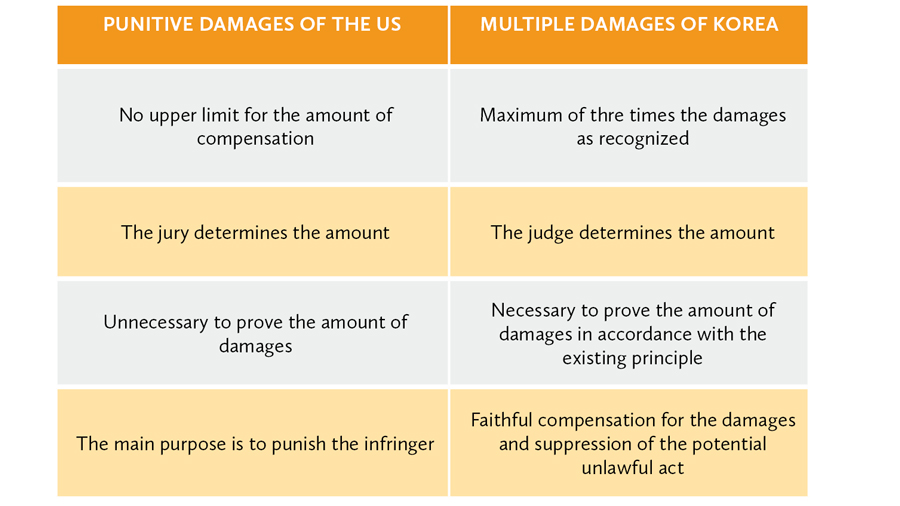
According to the revised system of multiple damages, damages can be awarded in the context of compensation maximum of three times, and it is where an act of infringement is recognized to be “willful” (articles 128 (8) and (9) of the Patent Act).
In addition, when determining whether the act of infringement is willful, the following are to be contemplated: (1) whether the infringer has a superior status; (2) whether the infringer had knowledge of the act of infringement, or the degree of awareness of the likelihood of damaging; (3) the significance of such damages; (4) economic profits gained by the infringer through the infringement; (5) the number of and infringements and periods of time for which they occurred; (6) the criminal penalty for the infringing acts; (7) the infringer’s financial status; and (8) what efforts the infringer has made to reduce or mitigate the harm suffered by the patent owner.
Due to this amendment, the damage relief arising out of infringement upon the patent rights or exclusive licences will be expected to be strengthened, such that the distorted market order could be rectified and the patent invention could be invigorated. However, in order for the revised system of multiple damages to be paid off, the requirements for “willful infringement” in a civil remedy, which could be interpreted differently from a criminal case, along with the standard of proof need to be established.
The table provided below shows a comparison of the punitive damages in the US and the system of multiple damages newly introduced in the Korean patent law system.
This “multiple damages” provision will apply to acts of infringement committed after 9 July 2019. It will also apply to utility model infringements pursuant to the Utility Model Act, as well as to trade secret misappropriation under the Unfair Competition Prevention and Trade Secret Protection Act. However, this new provision does not apply to design patent or trademark infringement.
Protection of technical or commercial ideas communicated between parties
Under existing Korean practice in the context of IPR protection, “ideas” standing alone were not subject to protection under the Copyright Act or the Patent Act. They were subject to protection only under separate contractual agreements in the context of civil laws. The amendment to the Unfair Competition Prevention and Trade Secret Protection Act has introduced a new provision (article 2 (1)(j)) to protect technical or commercial ideas communicated between business partners. The amendment to this act took effect on 18 July 2018.
The revised act has added article 2 (1)(j) as a new type of act of unfair competition: “An act of unjustly using ideas of economic value or ideas that constitute someone else’s technical or commercial information during business operations or process or transaction of commercial offers, bidding, public offering, etc., in contravention of the purpose for which such ideas are distributed for financial gains or an act of distributing such ideas to someone else for unjust purposes.”
 There was a loophole in protecting new ideas that were misappropriated by other business partners in the course of negotiations, especially because such ideas were normally premature to be utilized as patent or other IP protection means.
The Korean government expects this new provision will substantially help individuals and smaller companies against larger companies. On the other hand, all business entities, including larger companies, must be cautious not to be involved in misappropriation of others’ technical or commercial ideas during the course of business co-operation discussions with other entities
or individuals.
Facilitation of enforcement of IPR including patent and design patent rights with KCS
There has recently been a revision of a customs ordinance – (2019-1 Customs Office Ordinance promulgated on 14 January 2019, effective on 21 January 2019) – to effectuate the validity of IPR in the context of customs protection, and the said revision applies to the simplification of requisite documents for the purposes of making it easier to have a grant for patent or design patent rights upon customs recordation for the purposes of IPR protection.
(i) The valid term for applying for IPR customs recordation extended to 10 years from three years. If customs protection is sought for trademarks, copyrights, patents and designs with the KCS, he or she had to apply for the customs registration with the KCS, and had to subsequently apply for the renewal after three years. In other words, once the renewal term expires, another application for the renewal would be required for another three years.
However, under the recent amendments, the customs recordation term has been increased from three to 10 years, meaning it will no longer be necessary to renew KCS recordation every three years. However, the recordation will still expire if the underlying IPR expires.
(ii) Simplification of requisite documents upon application for customs recordation of patent and design rights. Upon application for customs recordation of patent or design rights with the KCS, it was mandatory to file evidences with a showing of infringement, unlike the cases of trademarks or copyrights. Under the 21 January 2019 revision, there would be no need to present the KCS with evidences with a showing of infringement, in the same manner in which it is unnecessary to present proof of infringement upon trademarks or copyrights. As such, the author expects the said revision to give rise to the level of customs recordation with the KCS with potential barriers removed due in large part to the simplification of procedures to record customs for patent and design rights.

BARUN IP & LAW
9th Floor, Saman Bldg, 520 Teheran-ro
Gangnam-gu, Seoul 06181, Republic of Korea
Email: office@barunip.com